Booking With Confidence - Redesigning Trust In Beauty Services
Existing beauty booking platforms prioritise speed over trust, leaving users uncertain about provider quality and reliability at the cost of their confidence to book. As the sole Product Designer on Luma, I explored how a booking experience could be reimagined around credibility, transparency, and emotional reassurance rather than availability alone. This shaped every design decision, directing the solution toward a trust-led platform that guided users from uncertainty to confident action.
Design Process
I followed the Double Diamond process for this project as the structured approach of exploring widely before narrowing down meant every design decision was rooted in research rather than assumption, something that mattered greatly given how layered and emotional the problem of trust turned out to be.
Discover
Market Research
Insight: The competitor analysis revealed that complex onboarding reduces booking confidence rather than building it, and that star ratings alone leave users searching for reassurance elsewhere.
Design Decision: Both findings directed me to move away from the conventional booking platform model entirely, ensuring that trust was built into the foundation of the experience rather than treated as an afterthought. This meant de-prioritising speed-first onboarding and surface-level social proof, and instead designing toward a platform that earned user confidence before asking for commitment.
Methodology: As part of my research, I signed up to several existing booking platforms as a consumer to gain a first-hand understanding of the end-to-end user journey and overall experience. Experiencing the onboarding, discovery, and booking flows directly helped me better empathise with users and identify moments of friction, uncertainty, and trust breakdown, I included these findings in the competitor analysis.
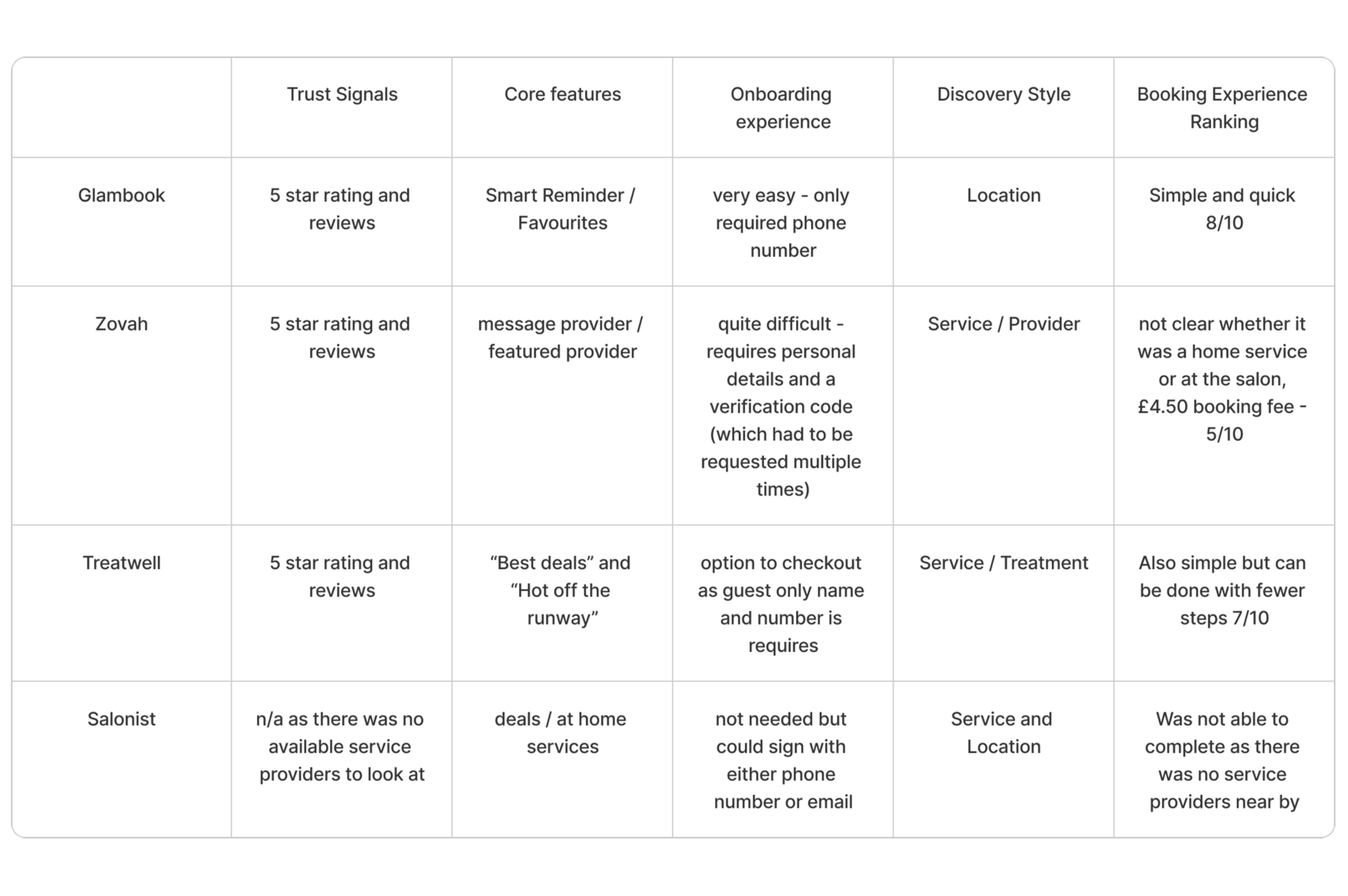
*Competitor Analysis Table*
User Research
Insight: Social listening across Reddit and TikTok deepened this further, revealing that users weren't just frustrated, they felt let down, at times violated, and increasingly anxious about trusting new service providers.
Design Decision: The depth of emotion behind these experiences made it clear that this was not a problem that could be solved with better UI alone. It revealed that the core problem users were facing was an emotional one, rooted in broken trust and repeated disappointment, and directed me to approach the design with that at the centre, ensuring every decision was made with the goal of rebuilding confidence and reducing anxiety throughout the booking experience.
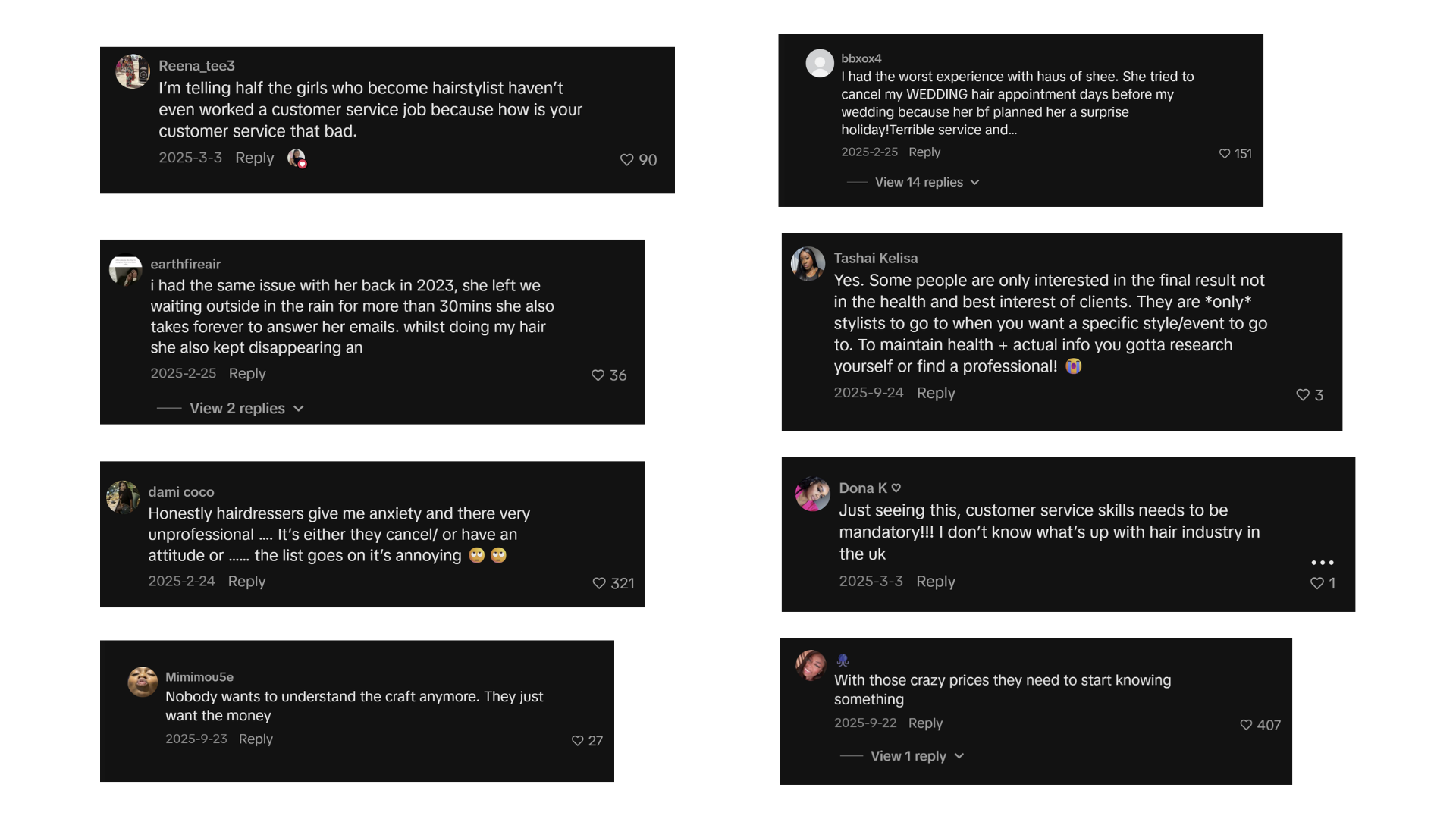
*Social Listening Findings*
While reviewing this content, I focused on answering the following research questions:
Where do you go to find a good hairstylist?
What things do you look for in a hairstylist before booking them?
What are somethings that can put you off booking a hairstylist?
What makes a hairstylist trustworthy?
What part of the booking process feel annoying or stressful?
What do you wish you knew before booking a hairstylist?
Define
Affinity Map
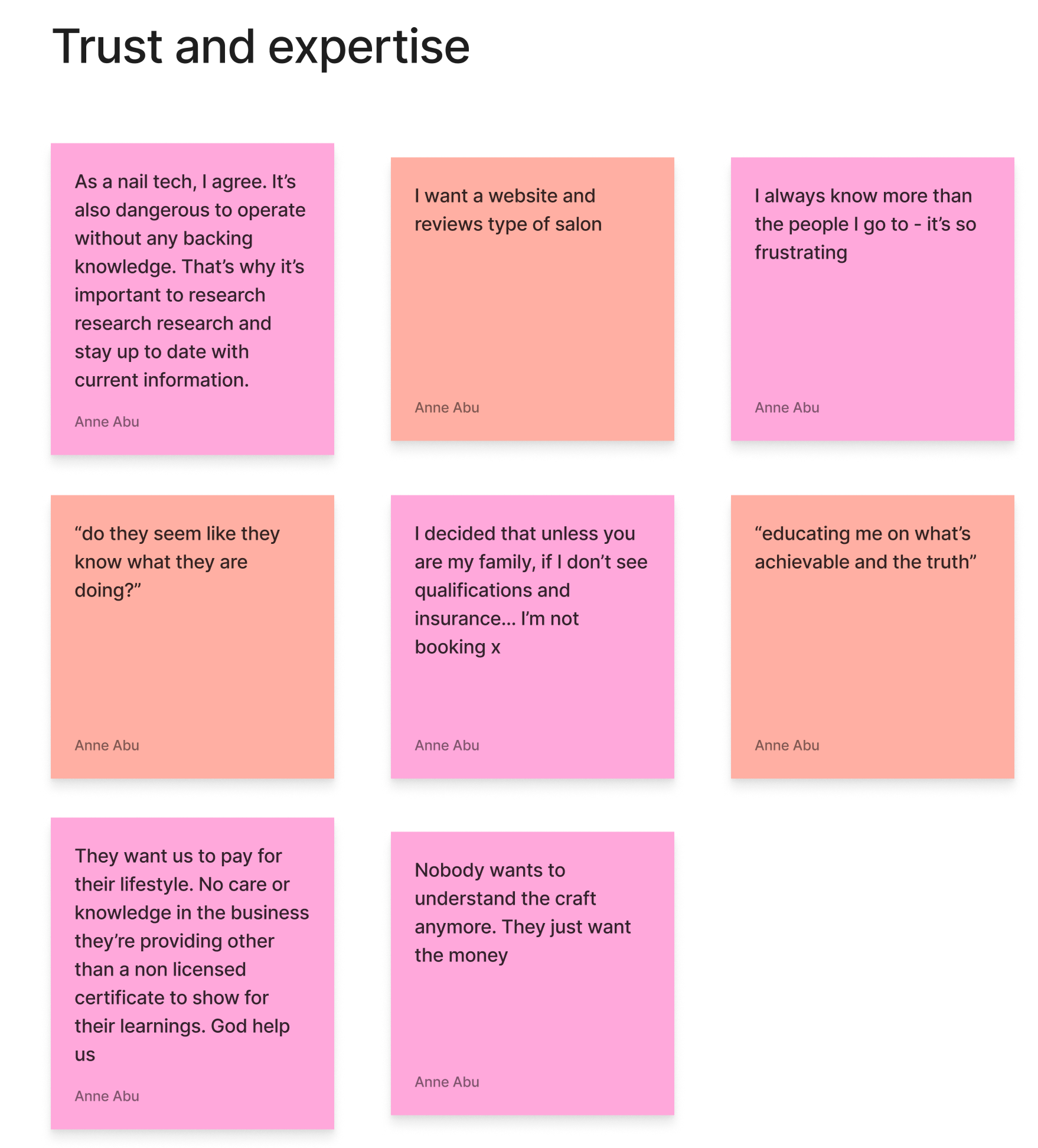
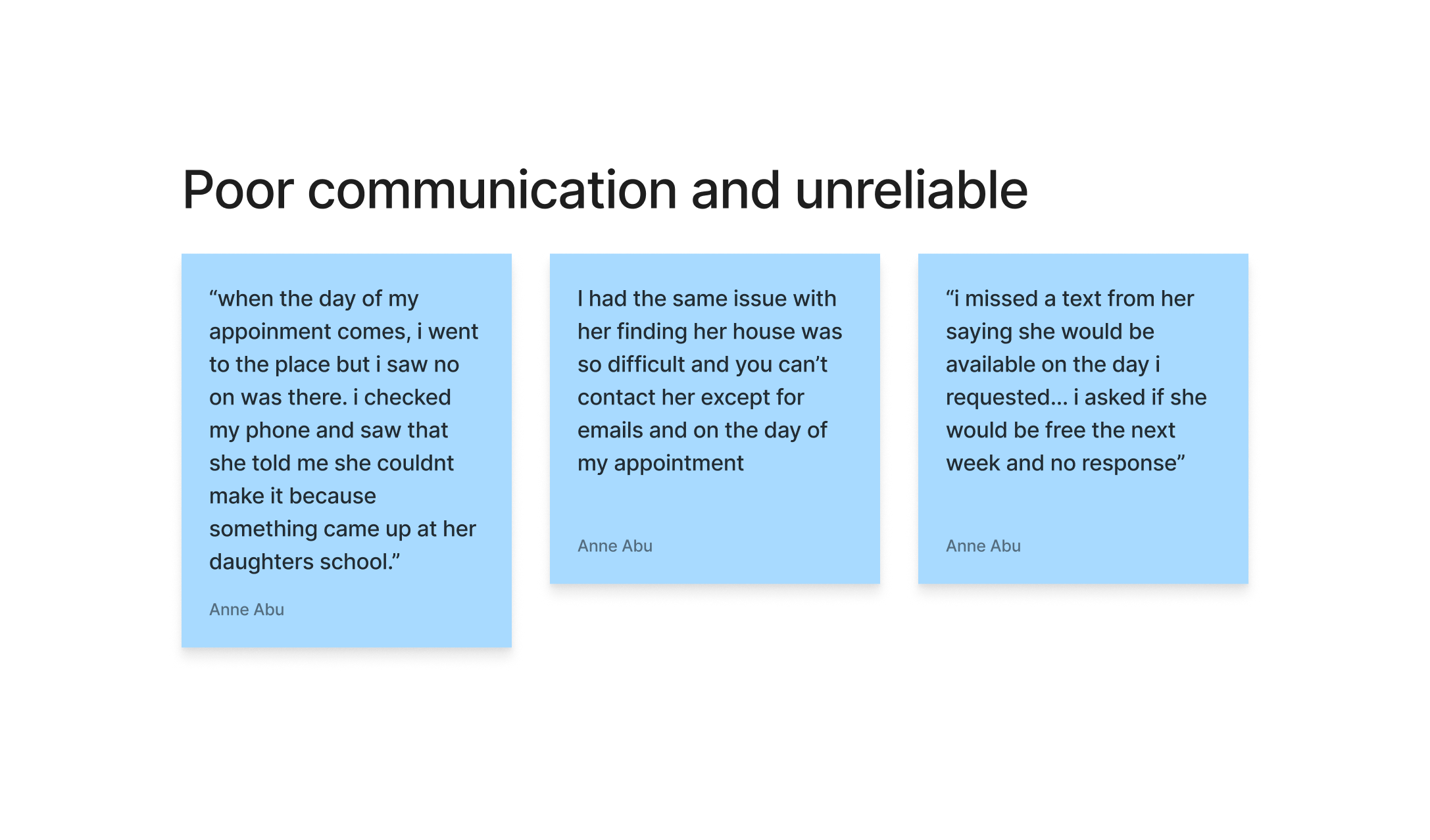
Insight: Affinity mapping the research surfaced two consistent themes: poor communication being interpreted as unreliability, and users actively seeking proof of expertise rather than assuming it. When neither was clearly present, users avoided booking altogether.
Design Decision: This established trust and expertise as the two pillars Luma needed to be built around, shaping the overall design direction and becoming the lens through which every subsequent decision was made.
Persona
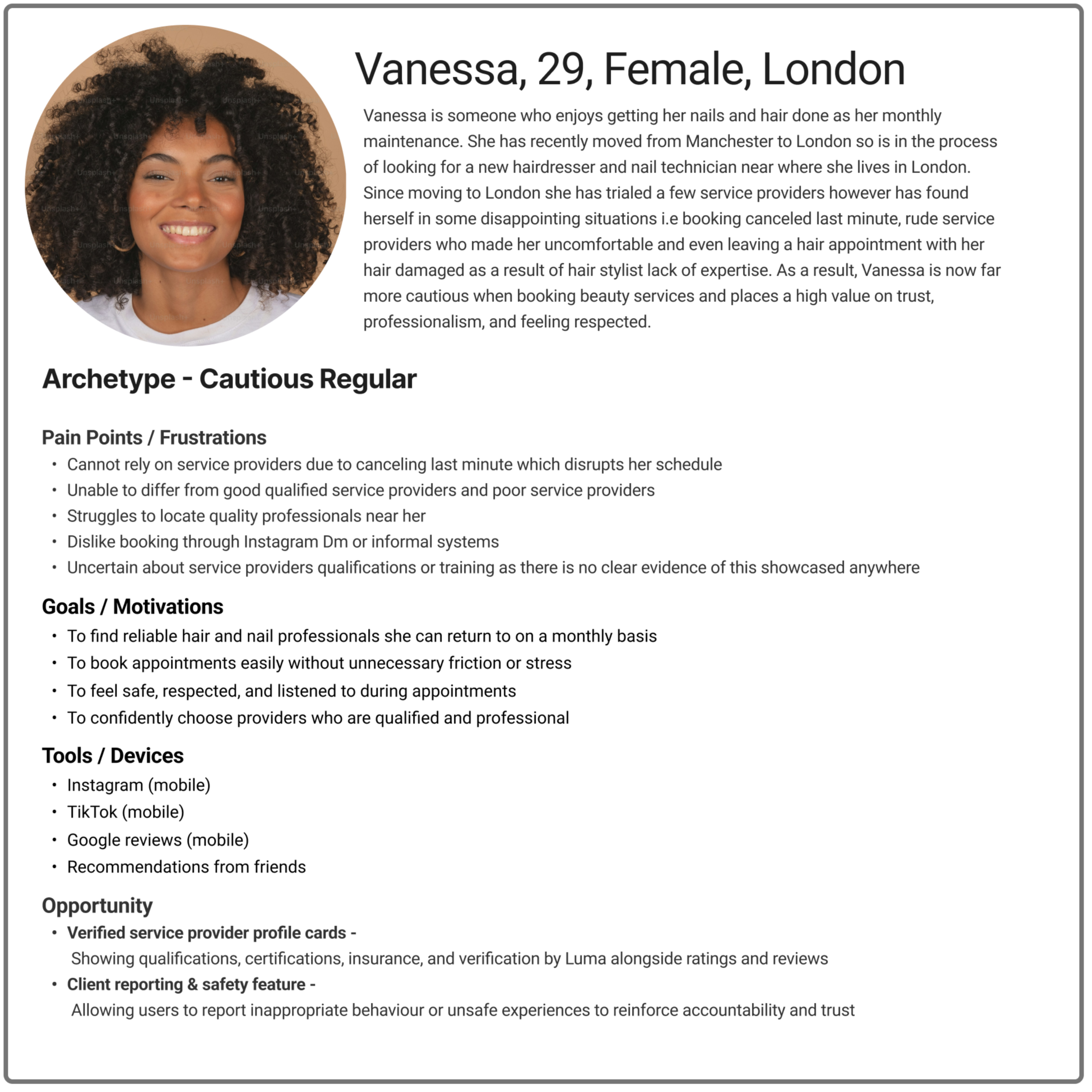
Insight: The persona brought this to life through Vanessa, who couldn't distinguish qualified providers from unqualified ones and had grown increasingly cautious after a series of negative experiences.
Design Decision: Vanessa’s story grounded the problem in human reality, confirming that the solution needed to work for someone who had already been let down multiple times and would need more than surface-level reassurance to book with confidence again.
Empathy Map
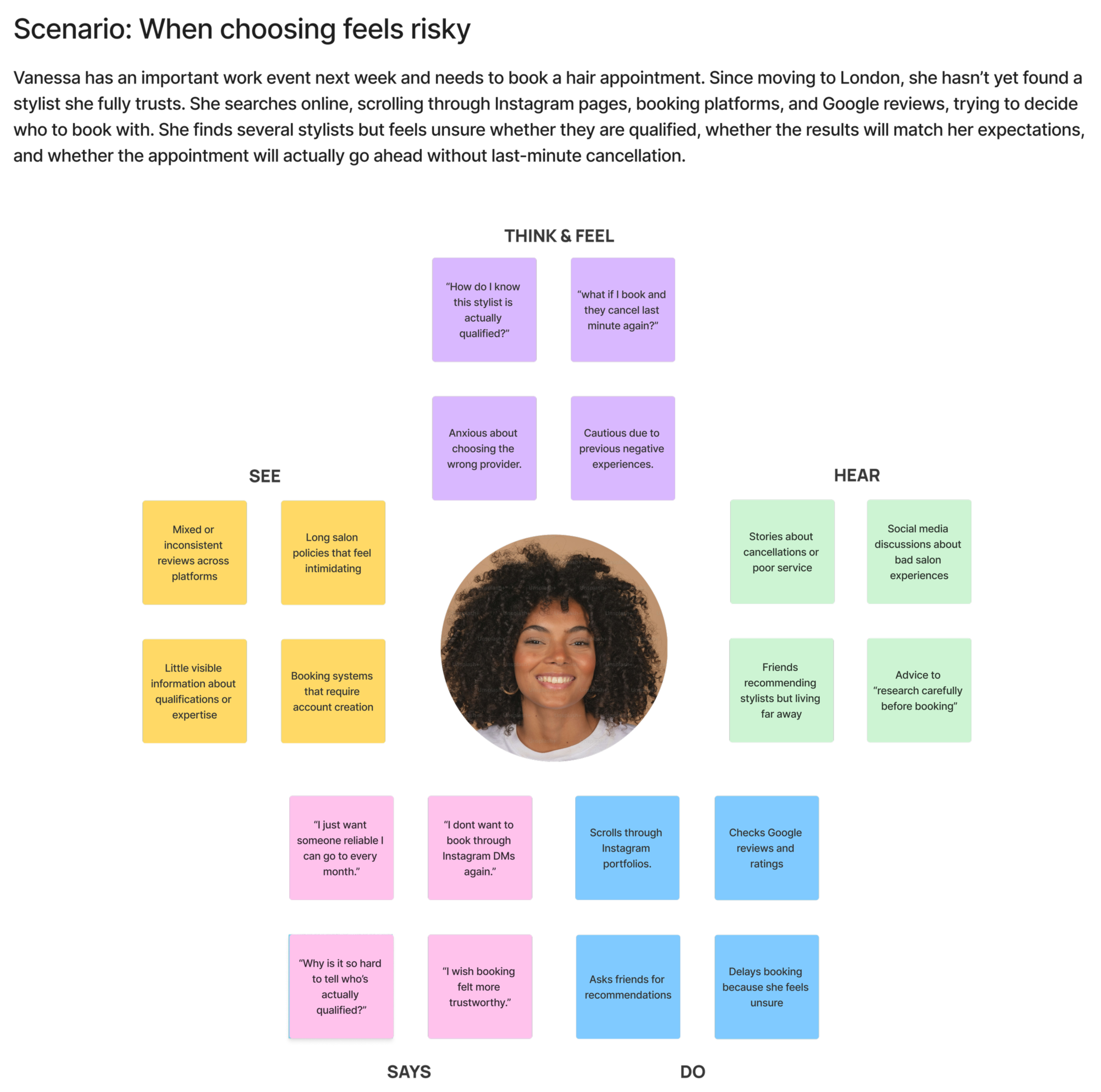
Insight: The empathy map then revealed just how much work Vanessa was doing on her own to feel confident, cross-referencing Instagram portfolios, Google reviews, and friend recommendations simply to fill the gap the platform wasn't closing.
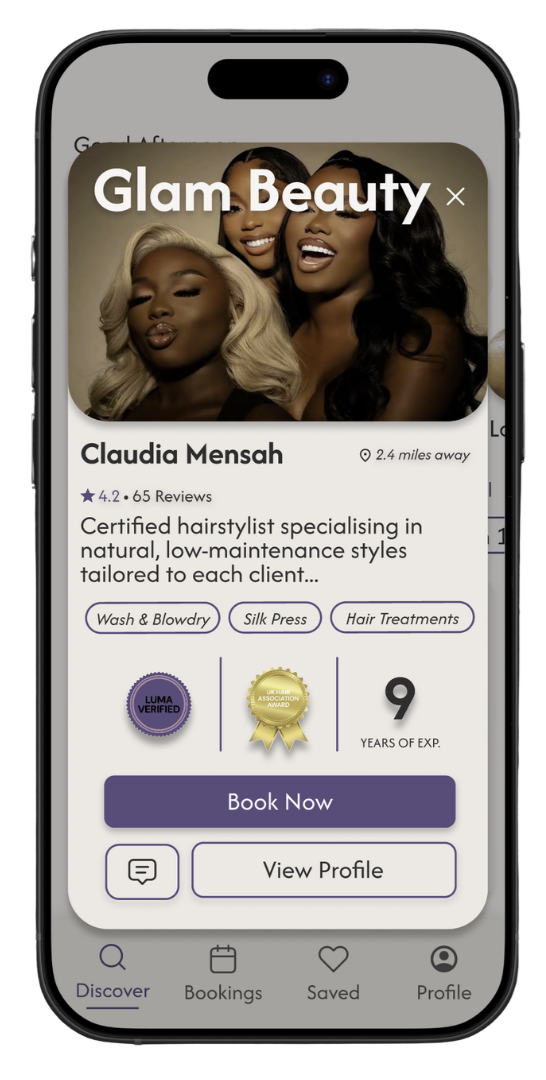
Design Decision: This pointed directly to the provider profile card as a feature, a single place where users could find the visual portfolio, verified credentials, and social proof they were currently having to search for themselves across multiple platforms.
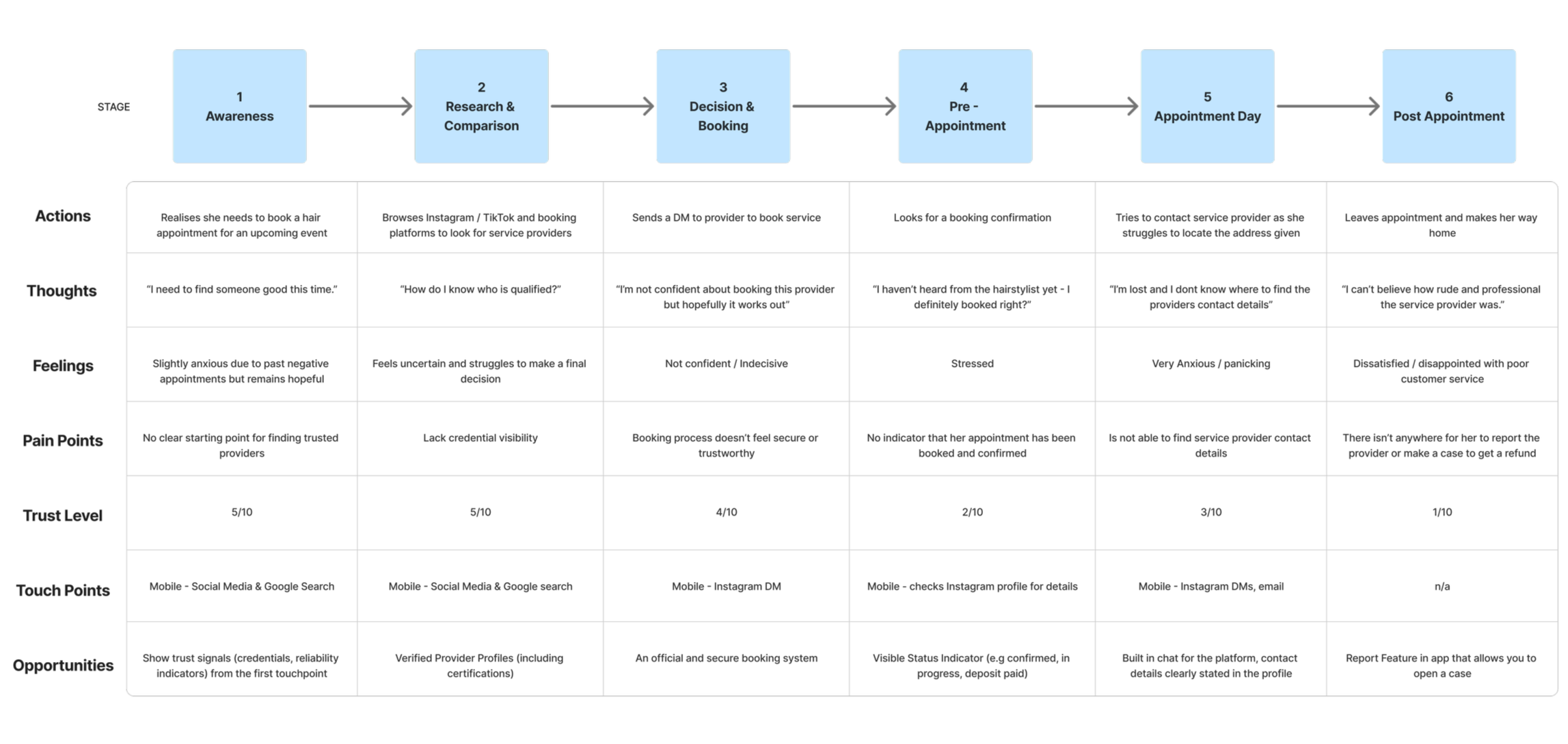
Experience Map
Insight: The experience map brought everything into focus, showing that distrust was setting in even after a booking was made, driven by poor communication and a lack of accountability for providers who let clients down.
Design Decision: This introduced the need for an appointment tracking feature, ensuring Luma provided reassurance beyond the point of booking and gave users a genuine sense of protection and confidence all the way through to their appointment.
Problem Statement
Cautious regular clients need a way to confidently identify and book qualified service providers, because users no longer assume provider competence and increasingly look for clear proof of training, certifications, and professionalism before committing to an appointment.
Hypothesis
I believe that clearer trust indicators and stronger post-booking reassurance will increase booking confidence and reduce anxiety throughout the entire journey. I will know this is true when we see an increase in completed bookings, repeat bookings, and overall user retention.
The Solution
Final Design Decisions: Every stage of the research pointed to the same conclusion: users needed a platform that built and maintained confidence across the entire booking journey, not just at the point of discovery. While many potential features were considered, I prioritised the service provider profile card and the appointment tracking feature as the two solutions that most directly addressed the core user needs around trust, transparency, and post-booking reassurance.
Reflection: If I were to revisit the project, I would use a feature prioritisation matrix earlier in the process to more rigorously evaluate each idea against user needs and business goals, ensuring the design decisions were not just instinct-led but systematically validated.
Feature 2: Appointment Tracking
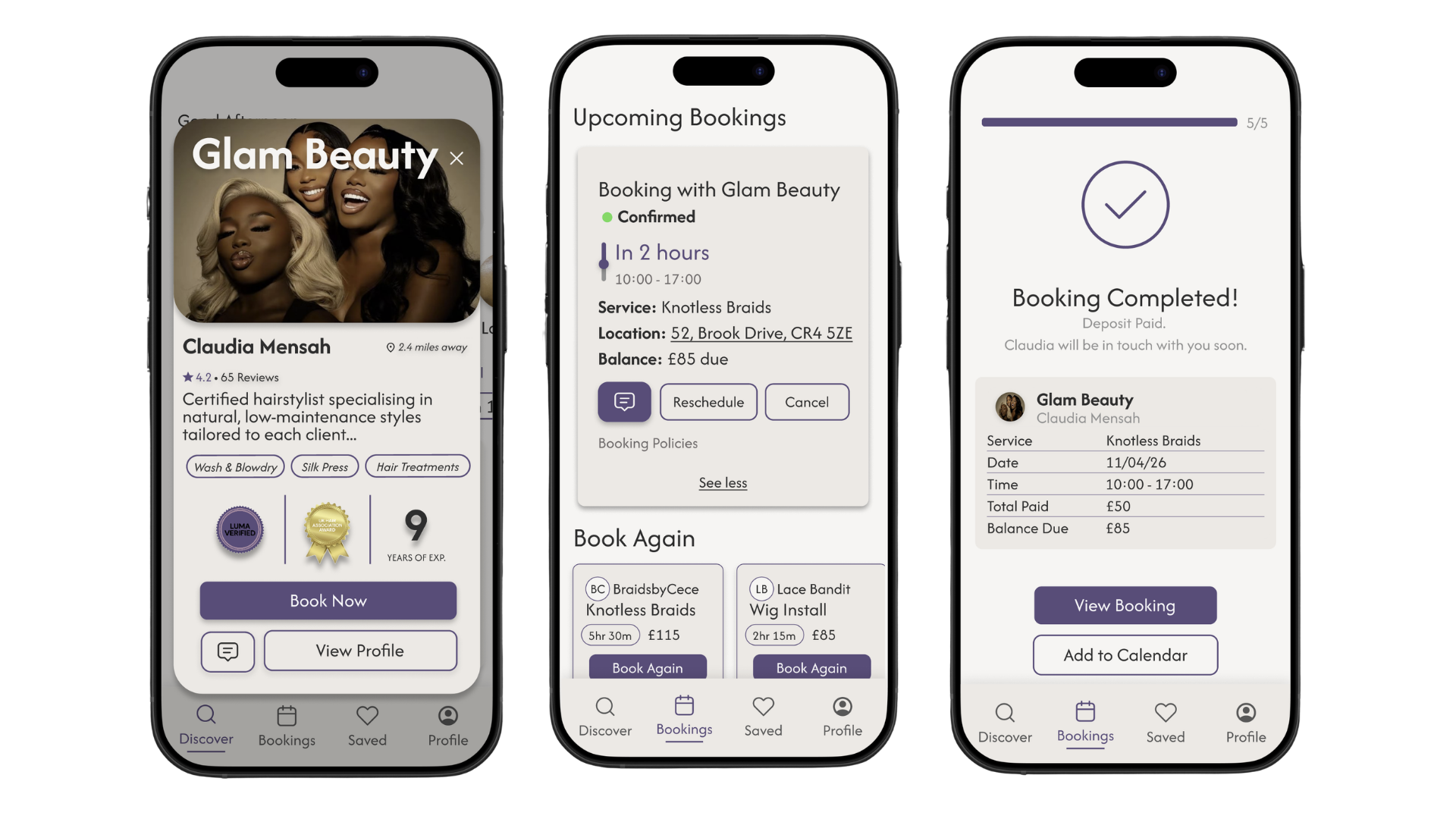
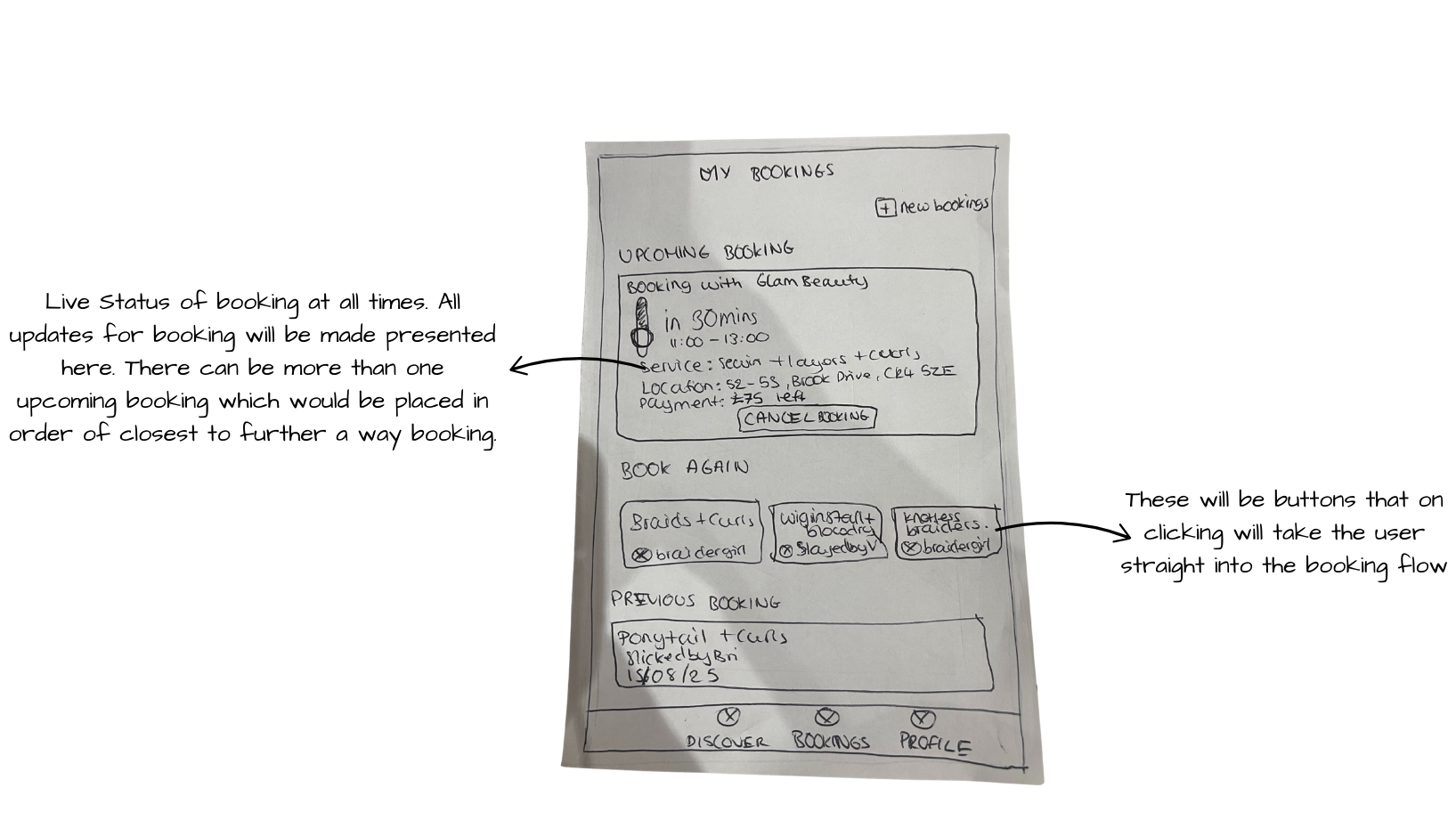
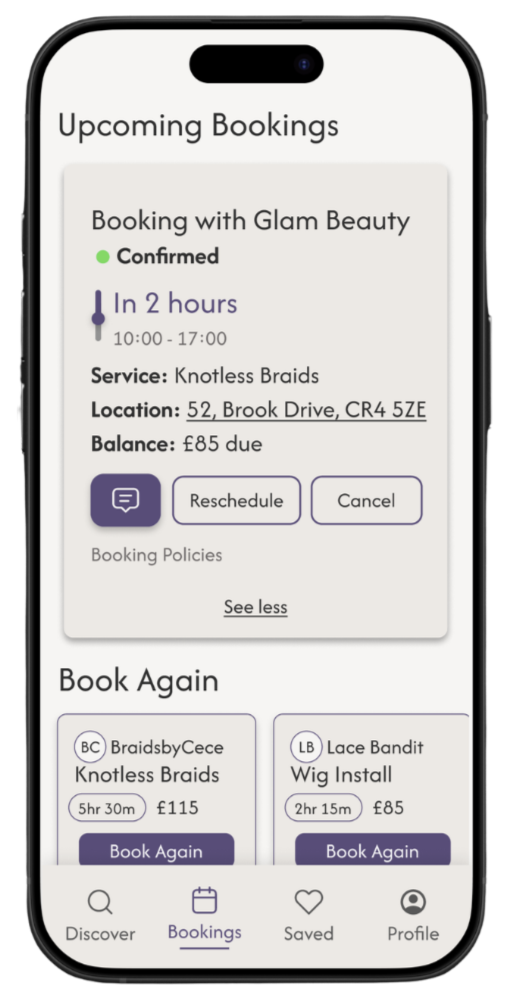
Users can check their booking status and any updates at any time within the “Bookings” section, while email and message notifications are sent upon confirmation to ensure users feel reassured and informed. Under “Upcoming Bookings” users are presented with a focused appointment view that surfaces the most relevant information at a glance, and then option to reveal extra details concerning appointment by clicking “see more” link. Live status updates, such as “30 minutes to your appointment,” alongside automatic reassurance email and message notifications will also be made available. This will help users feel informed and confident throughout the experience.
Accessibility Considerations: I simplified information density by introducing clear visual hierarchy, chunked content into digestible sections. Progressive disclosure allowed users to access deeper provider details when needed, rather than overwhelming them upfront.
Feature 1: Service Provider Profile Card
To strengthen trust before booking, each provider profile clearly displays key credibility indicators, including certifications, training history, and insurance status. Once credentials have been reviewed, a “Verified by Luma” marker is shown on the profile, helping users quickly recognise qualified professionals.
Accessibility Considerations: I made sure trust badges and ratings were supported by icons and labels to avoid relying on colour alone to communicate meaning, ensuring clarity for users with visual impairments or colour vision deficiencies.
Develop
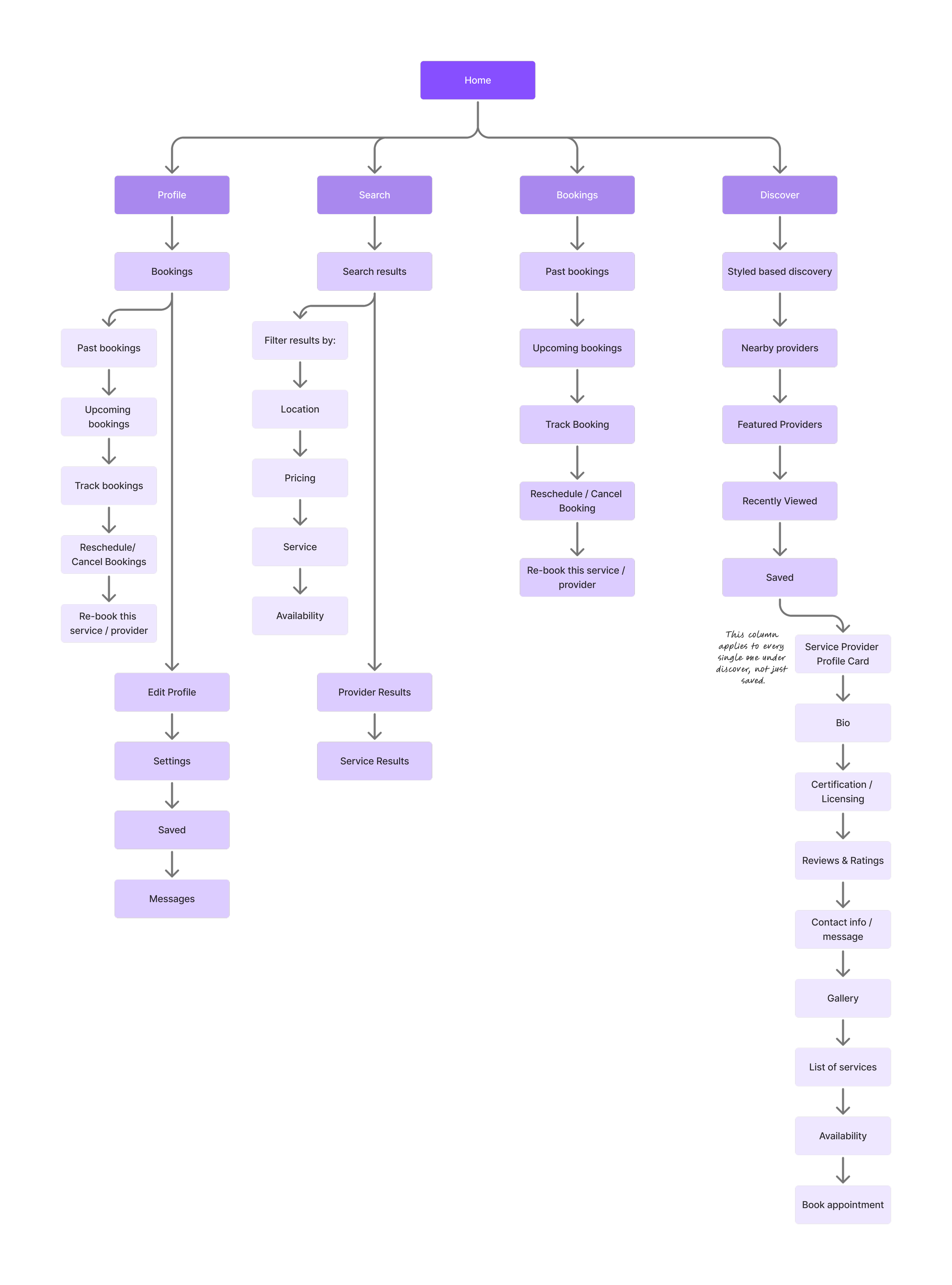
Sitemap

User Flow
*View Service Provider Profile Card*
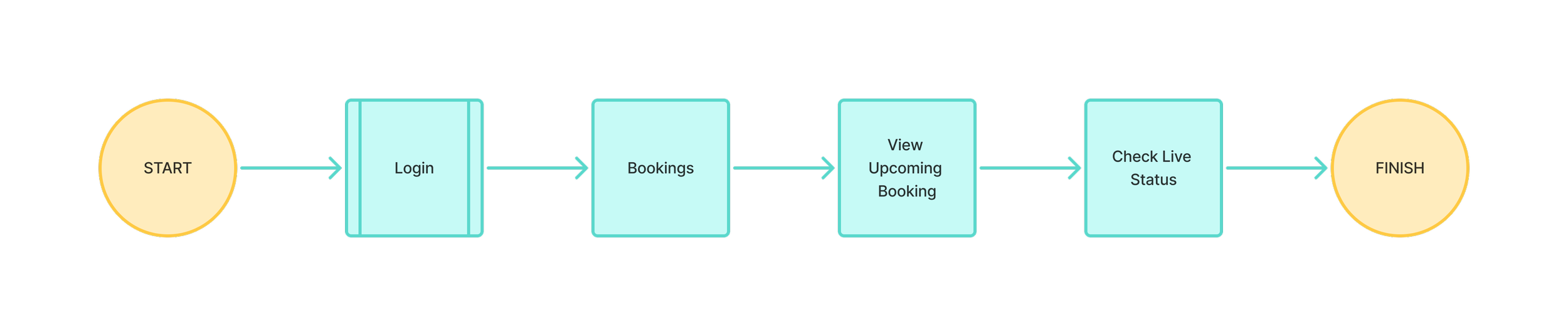
*Appointment Tracking*
Paper Wireframe
I initially sketched Option 1, but found the layout visually dense for a profile card and required too much interaction from the user. To improve clarity, I sketched other versions of the profile card and ultimately selected Option 2, which presents the same information in a more concise, accessible format, reducing cognitive effort for users while maintaining informational depth.
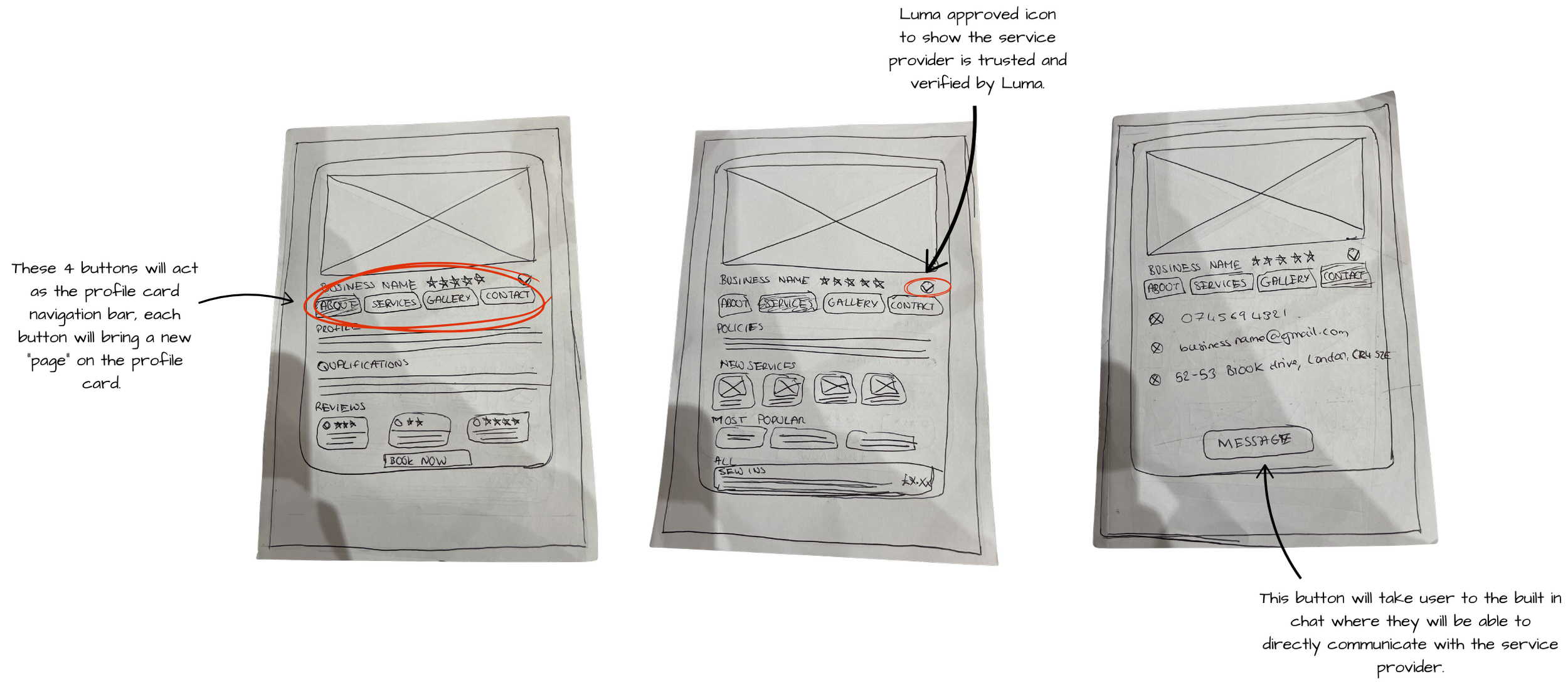
*Service Provider Profile Card - Option 1*
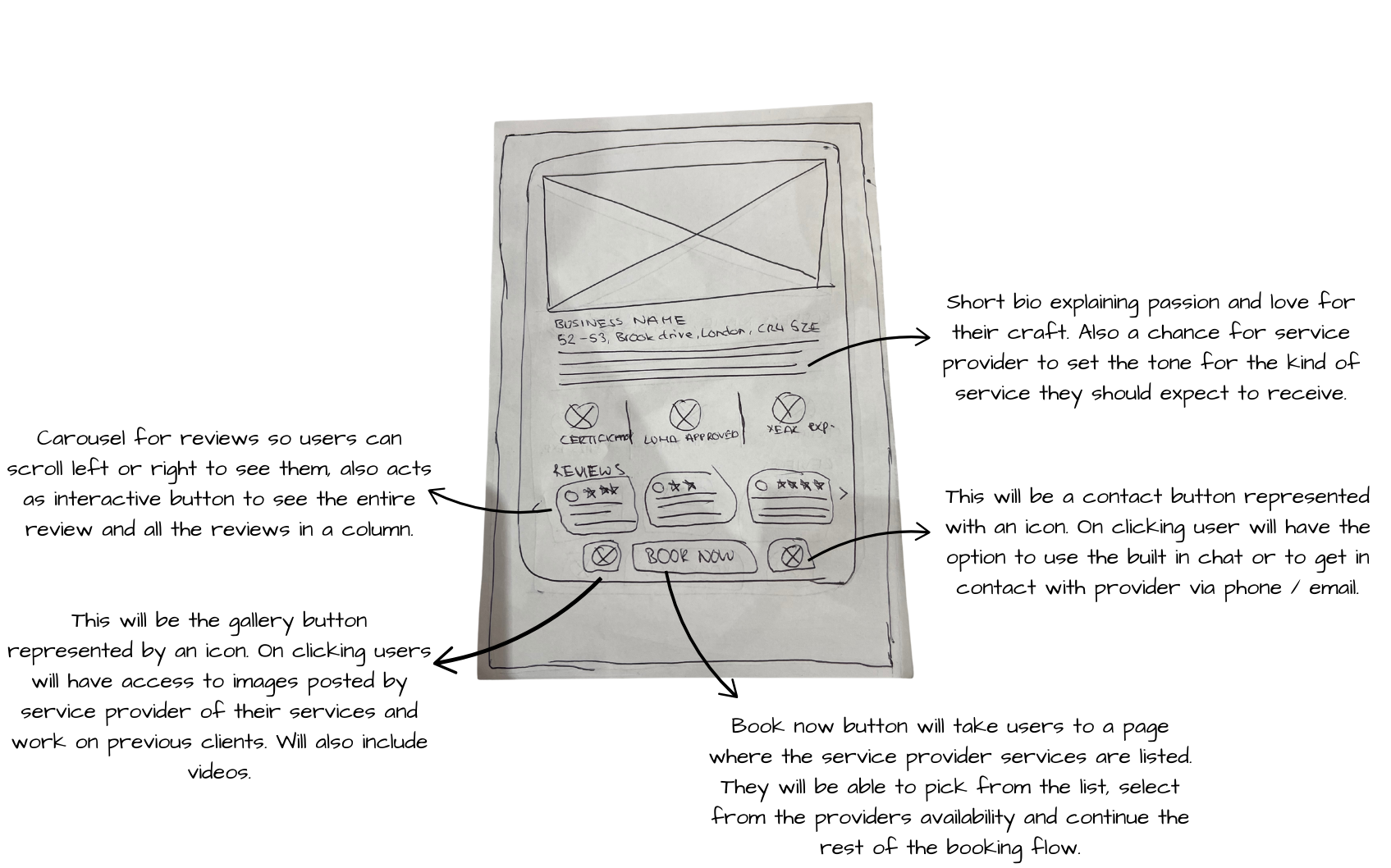
*Service Provider Profile Card - Option 2*
*Appointment Tracking*
Testing & Iterations
Hypothesis: I went into this test expecting Variant B to perform better. The content-first layout felt more structured, the information hierarchy clearer, and the credential panel easier to process at a glance. My assumption was that separating the image from the supporting details would reduce cognitive load and give users a faster, more confident path to booking.
Testing Results: A/B testing revealed that 66% of users preferred the content-first layout (Variant B) thus proving my hypothesis. On Variant B users consistently located credentials, services, and trust signals faster and with less effort than the more visually led alternative (Variant A). This confirmed that confidence is built through structure, not aesthetics, as users scan, assess, and decide in seconds rather than lingering on visual details.
Impact: The design was iterated accordingly, introducing separate service pills for scannability, a combined rating in place of individual quotes, a clearer CTA hierarchy, and a dedicated credential panel. These changes were designed to surface trust signals immediately, winning user confidence before they had the chance to hesitate.
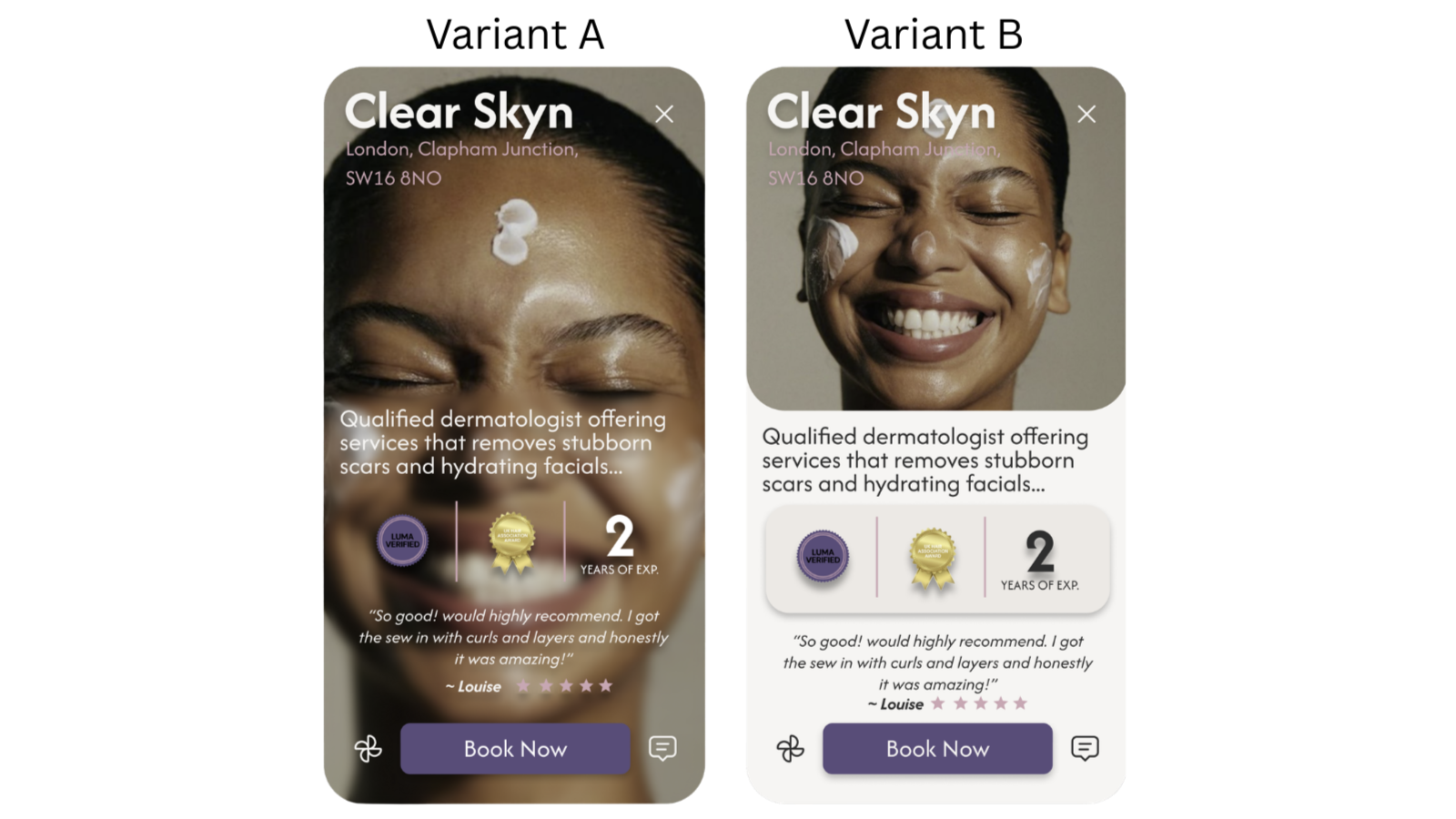
*Mid - Fidelity Service Provider Profile Cards*
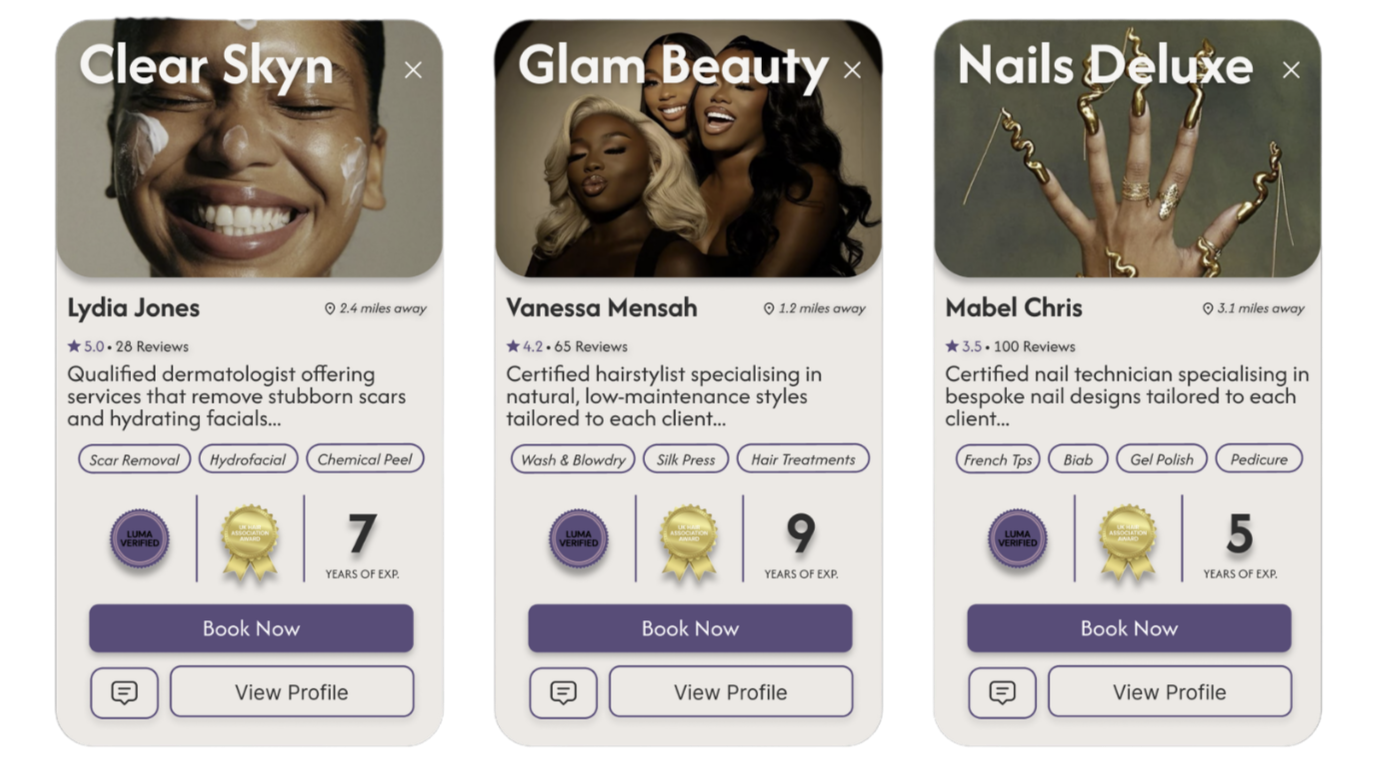
*Final Service Provider Profile Cards*
Trade Offs
Personalisation vs Scalability
Highly personalised profiles were considered but ruled out due to inconsistency and development complexity. Instead, modular profile components were designed to allow content variation within a consistent structure, balancing personalisation with scalability.
Information Depth vs Clarity
Displaying too much provider information upfront increased cognitive load and slowed decision-making, so I prioritised strong hierarchy and progressive disclosure, keeping the layout clean and scannable while allowing users to access deeper details when needed.
Reassurance vs Performance
Research showed users prioritised appointment clarity over behavioural metrics, so I focused the dashboard on booking status and provider details, keeping the structure open to future features like loyalty progress without compromising the reassurance-led experience.
Deliver
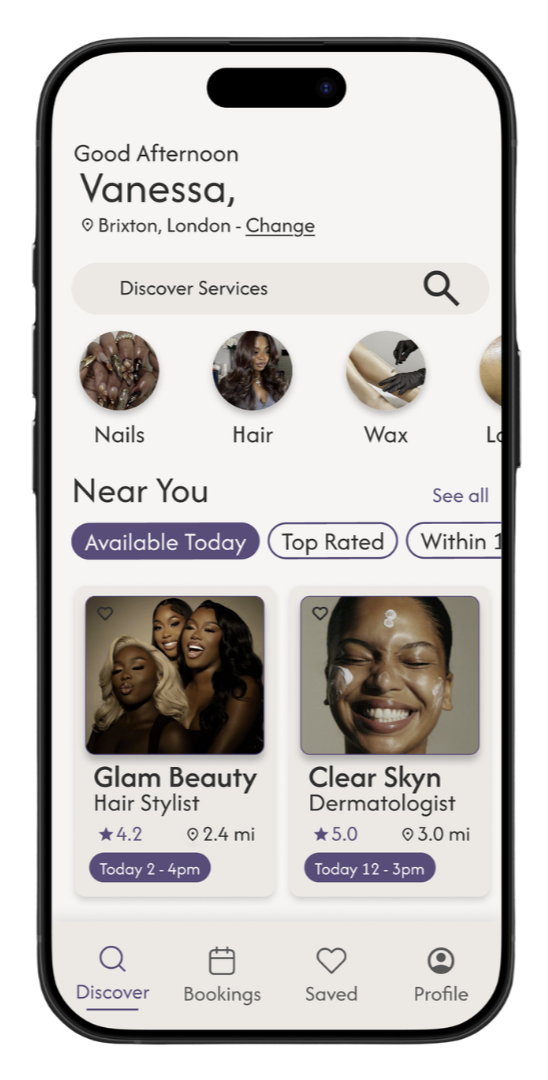
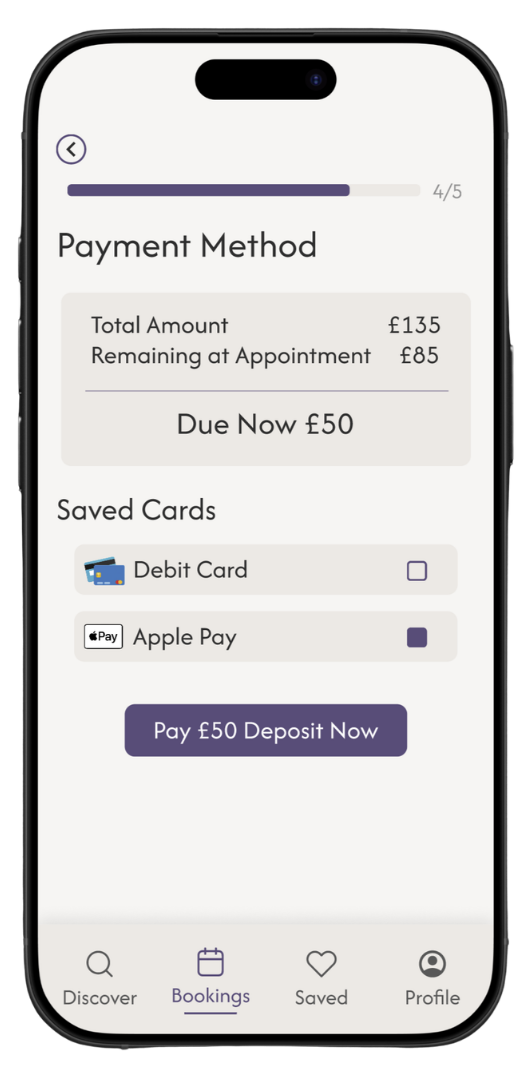
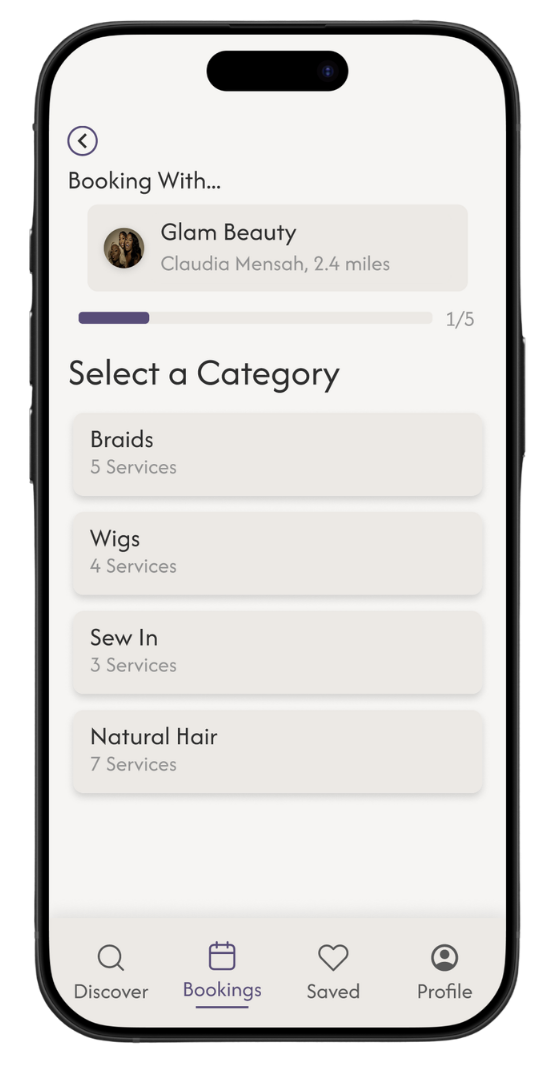
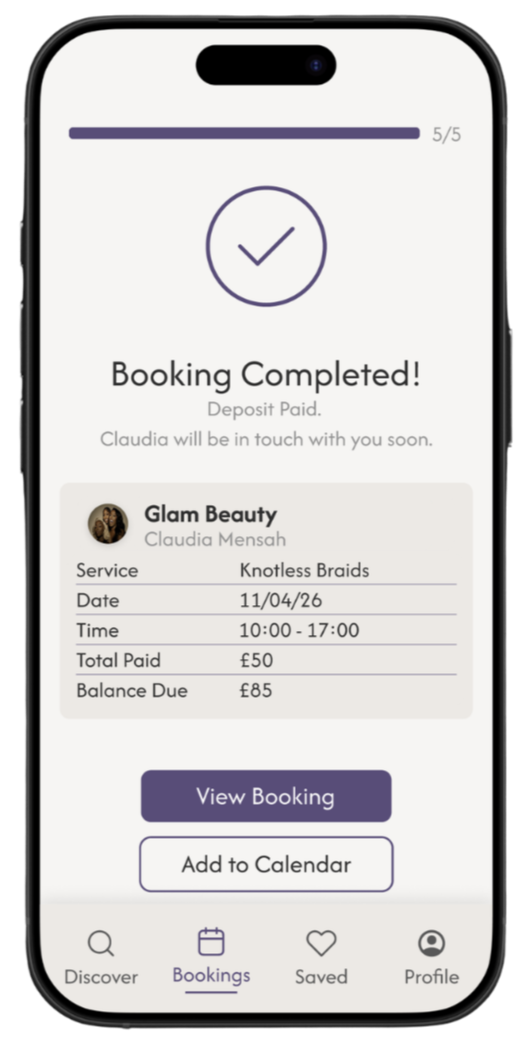
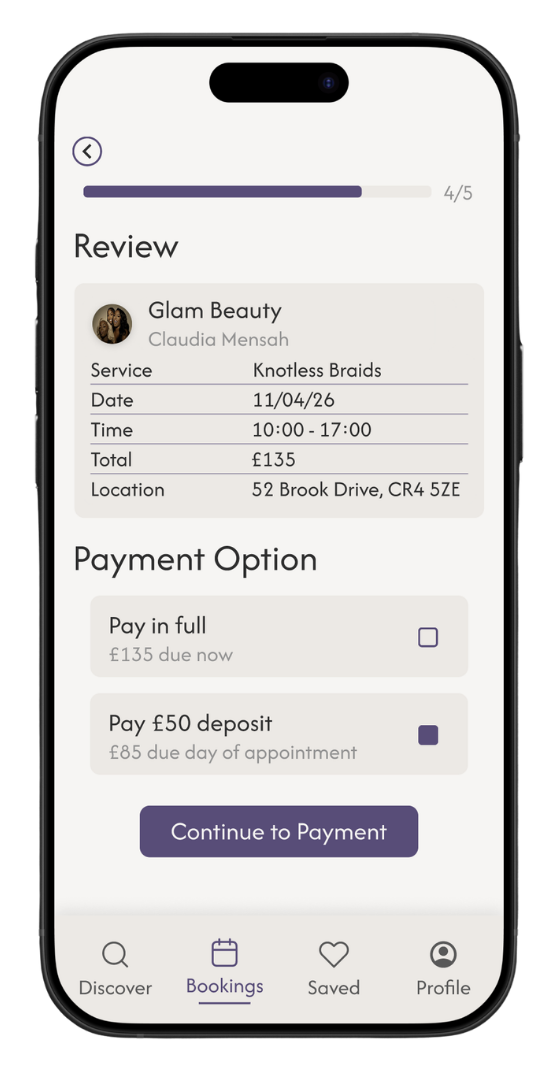
Final Prototype
Reflection
Possible Impact If Luma Was Brought to Life
If brought to life, Luma could shift beauty service booking toward a confidence-led marketplace, where trust, professionalism, and reliability drive user decisions. By making provider qualifications, credibility, and appointment status more visible, the platform could reduce booking anxiety and enable more informed choices. Over time, this approach could help raise industry standards by rewarding professionals who prioritise transparency, skill, and consistent service quality.
What I Would Like To Add
If I were to approach this project again, I would complement social listening with user interviews to gather deeper, more targeted insights. While analysing comments and discussions provided valuable context around user frustrations, direct conversations with participants would have enabled more specific responses to key research questions and strengthened the overall findings.
Key Takeaways
This project strengthened my UX and product thinking by pushing me to conduct a thorough research process that kept the user and their core problem at the centre of every decision. It was also my first experience running A/B testing, which showed me how comparing design variations provides clear, evidence-based direction rather than relying on assumption. Most importantly, it deepened my understanding of empathy in design, reinforcing that the most intentional design decisions come from a genuine awareness of users' emotions, motivations, and real world experiences.
View Next…
BeLingual
Role: Product designer
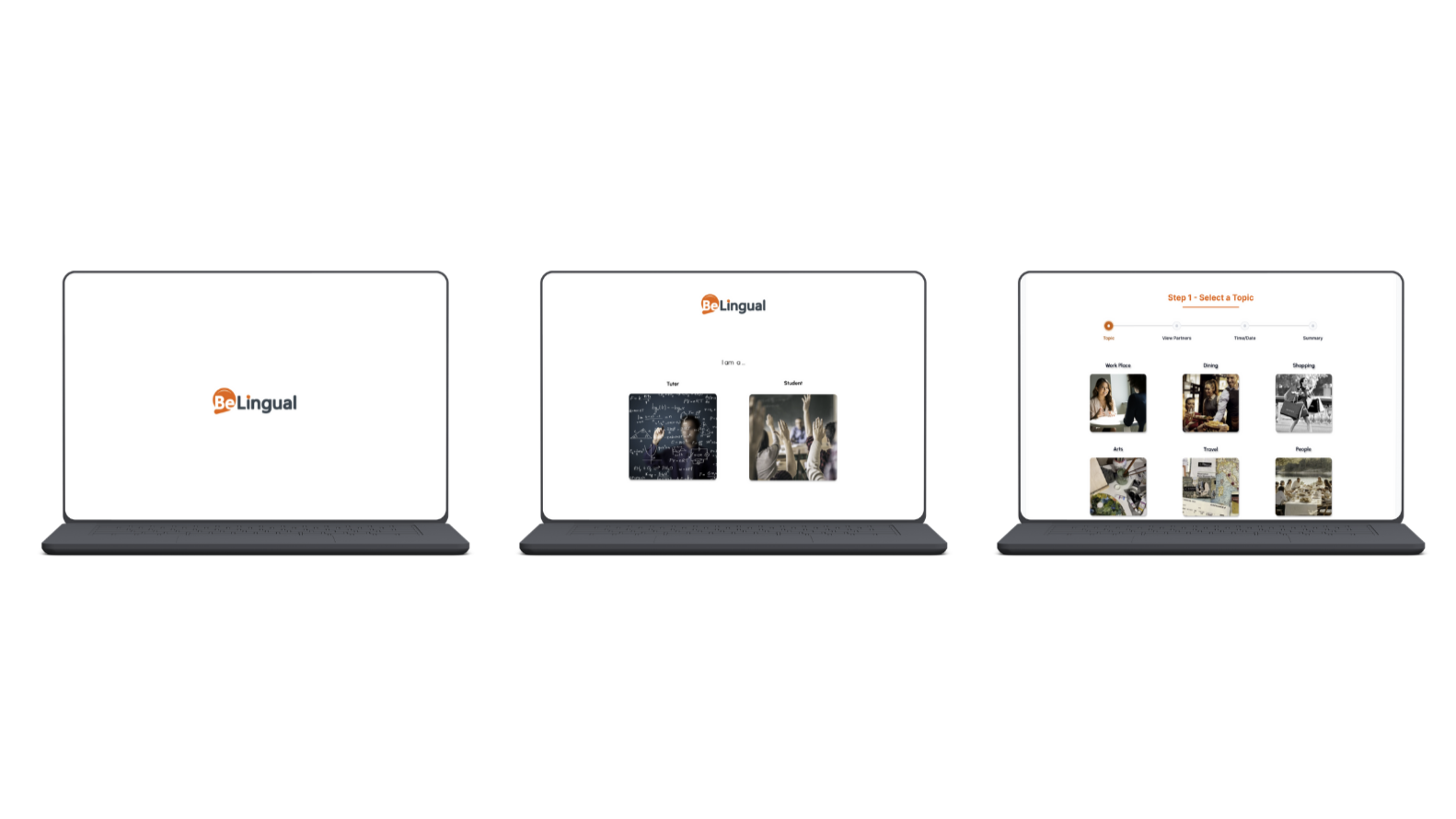
Product: BeLingual is a language learning platform designed to build speaking confidence through immersive practice and genuine community between students.
Impact: Improved language learning practices and grew the BeLingual community.
Tools: Figma
Project Type: Live Client Project
Bridging Barriers
Role: UX / UI Designer
Product: Bridging Barriers is a social mobility platform designed to connect ambitious young people from underrepresented backgrounds with the mentors, employers, and opportunities they need to become work-ready.
Impact: Repositioned Bridging Barriers as a career accelerator with a digital presence built to convert.
Tools: Figma, Figma Make, Claude AI, Chat GPT
Project Type: Freelance Client